
Ion exchange resins operate by reversible substitution of solution ions with fixed charged sites on a polymer matrix. Solvated ions approach resin pores with hydration shells that modulate effective size and interaction energy. Selectivity is governed by functional group affinity, cation and anion analysis ion valence and hydration energy, and is quantified by selectivity coefficients and distribution ratios. Transport combines film and pore diffusion with intra-particle migration that sets kinetics. Controlled elution alters ionic strength and counterions to displace bound species, and further explanation follows.

Fundamentals of Ion Exchange Chemistry
In aqueous systems, ion exchange chemistry describes reversible substitution of ions between a solid resin phase and a surrounding solution, governed by electrostatic attraction, selective affinity, and equilibrium constraints. The resin matrix presents fixed functional groups that confer charge and dictate counterion association; these groups anchor exchangeable sites while permitting ion mobility within microdomains https://laballiance.com.my/. Solvated ions approach with hydration shells that modulate effective size and interaction energy, influencing desolvation penalties during sorption. Thermodynamic control arises from activity coefficients, ion valence, and concentration gradients; kinetics depend on pore diffusion and interfacial transfer rates. The process permits predictable substitution sequences under controlled conditions, enabling operators to design protocols that respect system freedom by focusing on controllable variables rather than arbitrary assumptions.
Resin Selectivity, Capacity and Transport Mechanisms
Several key parameters—selectivity, capacity, and transport properties—govern resin performance and must be quantified to predict separation outcomes. Resin selectivity arises from functional group affinity, ionic radius, and hydration energy; quantification uses selectivity coefficients and distribution ratios to rank ions under given conditions. Capacity is expressed as total exchange sites (meq·g−1) and effective operating capacity, reduced by irreversible binding and fouling. Transport mechanisms combine pore diffusion, film diffusion, and intra-particle migration; modeling employs effective diffusion coefficients and Thiele modulus analogs. Binding kinetics determine uptake rates and influence peak shape and resolution. Matrix interference from competing ions, organic load, or complexants alters apparent selectivity and reduces usable capacity. Accurate characterization enables controlled, adaptable separations without operational constraint.
Practical Elution Strategies and Troubleshooting
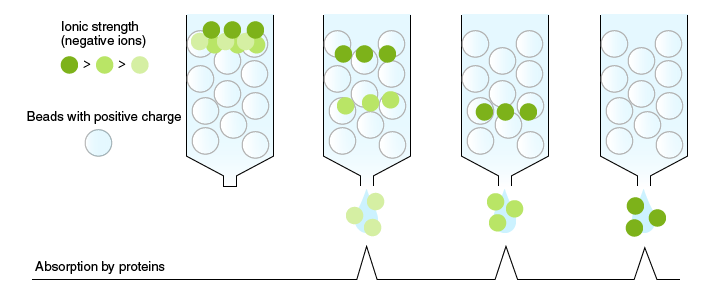
For effective elution, operators must select conditions that disrupt targeted ion–resin interactions while minimizing co-elution and resin degradation. Practical elution strategy emphasizes controlled gradient elution profiles, judicious choice of counterion strength, and solvent composition to tune selectivity. Salt displacement techniques are applied when ionic strength adjustments alone cannot resolve closely retained species; incremental salt concentration ramps permit selective displacement without abrupt resin loading changes. Troubleshooting focuses on diagnosing tailing, peak splitting, or capacity loss via systematic variation of pH, ionic strength, and flow rate, and by inspecting resin fouling. Regeneration protocols and compatibility with column hardware preserve functional groups. Documentation of method parameters enables reproducibility and rapid restoration of separations, supporting operator autonomy and analytical freedom.